


In Nepal, pottery is not just about clay and craftsmanship — it is about connection. The humble pot, shaped by skilled hands and fired under the sun, carries within it the story of faith, culture, and the rhythm of daily life.
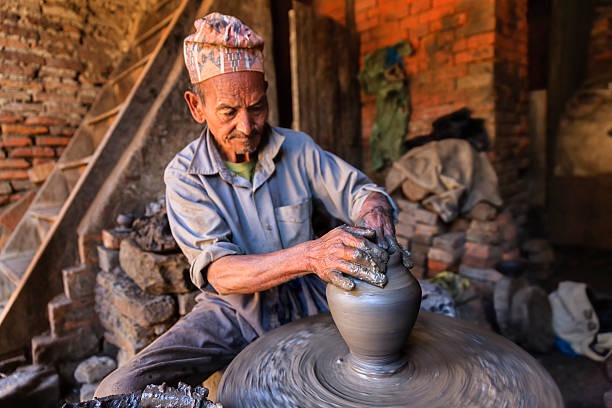
Image source: Stock Images, Royalty-Free Images, Illustrations, Vectors and Videos – iStock
Stroll up and down the lanes of Bhaktapur, or Thimi and you will hear the whirr of the spinning mules, and will observe piles of new moulded pots drying in the sunshine. To the Prajapati people, the traditional potters of Nepal, this art is not just a source of livelihood but an art that is inherited by the community and is heritage to a given generation.
Sacred Clay and Sacred Rituals.
Ever since the dawn of time, clay has been a spiritual representation to the Nepalese society. It is pure during Hindu and Buddhist rituals, the earth itself. A clay vessel is a vessel exemplifying holy water that is stored in temples and homes as kalash. During Tihar, small earthen lamps (diyas) are lit in doorsteps to lead good luck and drive away darkness.
Pottery plays the leading role in Newar cultures, during feasts and festivals. The well-known Juju Dhau – the King of Yogurt is never served in large dishes, as it is believed that the food will not only taste better, but it will be more holy as well. The rituals in the end of life are also completed with clay: ash of cremation is stored in earthen urns and then sent to rivers, which signifies the coming of the soul – and of clay – back to the earth.
Convention Confronts Change.
Although tradition is still the central focus of pottery, it has been transformed in its mode of expression. At the Pottery Square of Bhaktapur, artists are moulding religious as well as contemporary designs. One potter could be shaping a classic diya, another one could be creating some smooth and minimalistic vases that can be exported. The difference between the old and the new represents how Nepal manages to strike a balance between the past and the present.
Over the past few years, the re-invention of clay has begun with designers and young entrepreneurs, who are attempting to apply eco-friendly techniques and modern aesthetics to make pottery attractive to the modern markets. What used to be used in temples and in the kitchen is used now in cafes, hotels, and houses.
Struggling Below the Surface.
There is a struggle however, behind the beauty. The need to use pottery on a daily basis has been lowered thanks to cheaper plastic and metal containers. Most potters are struggling with the increase of clay prices, and they do not enjoy popularity. Other younger individuals in pottery families opt to stay out of it, abandoning the wheel.
But hope persists. Pottery tourism is being encouraged by community projects and local organizations, giving the chance to the visitor to have the first hand experiences of the craft itself. In Bhaktapur and Thimi workshops, they are welcome to sit at the wheel, experience the texture of damp clay and are able to feel the patience and the craft work it requires.
The Soul of Clay
Pottery in Nepal remains to possess the spirit of cultural individuality – the combination of mightiness, creativity, and human soul. Each pot has its tale: of ceremonies which fix the deities, of families which keep the tradition, of hands which will not lose the art of the earth.
And till the kiln is closed and the wheel is turned, the spirit of Nepal will keep on making forms, a clay pot at a time.


